From Data to Decisions: How AI Is Making Workforce Intelligence Actionable
Updated: September 11, 2026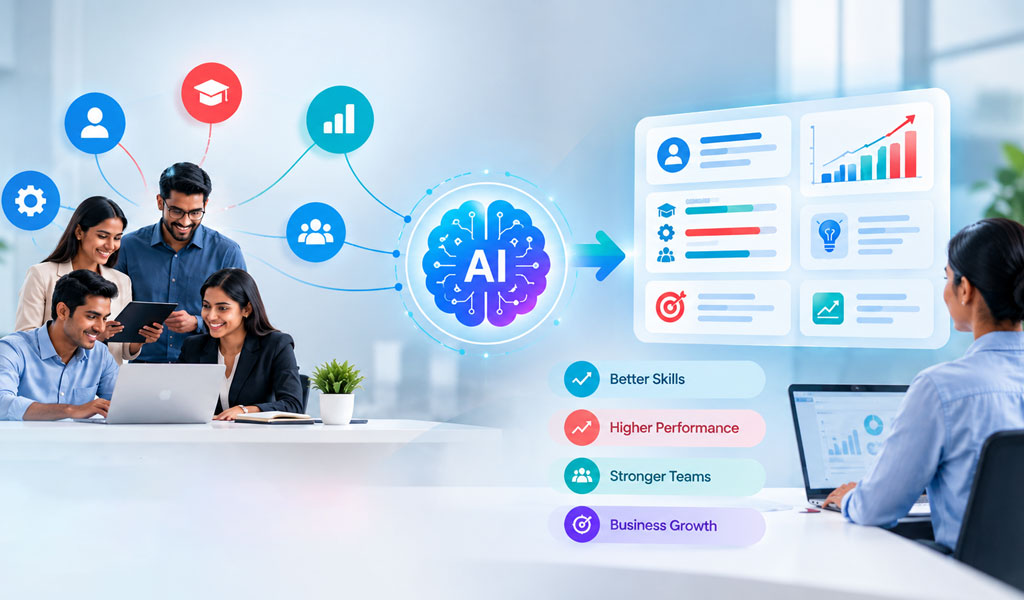
The Workforce Is Changing
Why Skill Management Needs to Evolve
The workplace is changing faster than ever. New technologies, evolving job roles, and shifting business priorities are creating new skill requirements across industries.
For organizations, understanding workforce capabilities is no longer just about identifying what employees are missing. It is about having a clear view of the skills available today and the capabilities needed for tomorrow.
Traditional skill assessments often provide a snapshot of employee capabilities. But skills continuously evolve as people learn, roles change, and new technologies emerge.
This is where Artificial Intelligence is transforming workforce development, helping organizations move from simply identifying skill gaps to building continuous skill intelligence.
Turning Workforce Data Into Meaningful Action
Organizations today generate enormous amounts of workforce data-from employee performance and skills to learning activity, certifications, engagement, and career development. But data alone does not create better decisions. The real challenge is turning this information into meaningful insights that help organizations understand their people, identify opportunities, and take the right action at the right time. This is where Artificial Intelligence (AI) is transforming workforce intelligence. AI can connect information from different areas of the employee lifecycle, identify patterns, and turn complex workforce data into actionable insights. Instead of relying only on spreadsheets, reports, and disconnected systems, organizations can use AI to create a more connected and proactive approach to workforce management.
The shift is simple:
Data → Insights → Decisions → Action
Why Workforce Intelligence Matters
Workforce intelligence goes beyond collecting employee information. It is about understanding what that information means for people and the organization.
Businesses need answers to questions such as:
- Where are our critical skill gaps?
- Which capabilities will we need in the future?
- How can employee performance be improved?
- Are our learning programs creating meaningful impact?
- Which employees need additional development?
- Are our teams prepared for changing business requirements?
When workforce data is connected, these questions become easier to answer. For example, an employee’s performance data becomes more valuable when it is viewed alongside their skills, learning history, role requirements, and development opportunities. AI helps bring these connections together, allowing organizations to move from simply seeing data to understanding it.
From Data Collection to Intelligent Insights
Many organizations already have systems that collect workforce information. The challenge is that this information often exists across multiple platforms. Learning data may be stored in an LMS. Performance information may exist in another system, while skills, certifications, and employee records may be managed separately.
This creates a common problem:
More data does not always mean more visibility.
HR and business teams can spend considerable time collecting, organizing, and interpreting information before they can actually act on it. AI can help reduce this gap. By analyzing multiple workforce signals, AI can identify patterns, highlight important changes, and bring relevant insights to the attention of decision-makers. The goal is not to replace human judgment. It is to make that judgment faster, smarter, and more informed.
How AI Makes Workforce Intelligence Actionable
1. Personalized Employee Insights
Every employee has a different combination of skills, experience, performance, and learning needs. AI can help organizations analyze these factors at an individual level and identify relevant development opportunities. For example, an employee may be performing well in their current role but lack a capability required for their next position.
Instead of simply identifying the skill gap, AI can help organizations understand:
What is missing?
Why does it matter?
What can be done about it?
What should happen next?
This transforms workforce intelligence into a continuous employee development process.
2. From Skill Gaps to Skill Intelligence
Skill gaps are no longer just an HR concern. They directly influence an organization’s ability to adapt and grow. Traditional skill-gap analysis often focuses on what employees lack today. AI enables organizations to look ahead and identify the capabilities they may need tomorrow. For example: Current Skills → Skill Gaps → Required Skills → Learning → Future Readiness
This approach helps organizations align employee development with changing business priorities.
Instead of asking only:
“Where are our skill gaps?”
Organizations can begin asking:
“What skills will we need next, and how can we build them?”
That shift is essential for creating a workforce that can adapt to change.
Connecting Learning With Performance
Learning generates valuable data-course completions, assessment scores, certifications, learning hours, and participation. However, completing a course does not automatically mean that an employee has developed the required capability. AI can help connect learning data with performance and skills to provide a more complete picture.
Organizations can use these insights to understand:
- Which learning initiatives are most relevant
- Where employees need additional support
- Which capabilities require reinforcement
- Where personalized learning can help
- How learning can better support business goals
The focus therefore moves from:
“Did the employee complete the training?”
to:
“Did the learning help the employee become more capable?”
This makes learning more measurable, meaningful, and connected to business outcomes.
AI as a Decision-Support Layer
One of the biggest opportunities for AI in workforce intelligence is its ability to support decision-making. A traditional dashboard may show performance scores, training completion rates, or certification status. An AI-powered approach can help explain what those numbers mean.
For example: Performance changes → Identify the affected capability → Understand the learning history → Identify the development need → Take action
This turns workforce dashboards from information displays into decision-support tools. Instead of simply asking leaders to interpret data, AI can help surface the insights that deserve attention. The result is a more connected decision-making process.
Enabling Proactive Workforce Decision-Making
Effective workforce management is not only about responding to existing challenges. It is also about anticipating what the organization may need next. AI can analyze workforce trends, skills, performance, learning activity, and other relevant signals to help organizations identify emerging needs earlier.
This can support leaders in areas such as:
- Identifying emerging skill gaps
- Planning future learning requirements
- Recognizing changing performance patterns
- Preparing employees for evolving roles
- Aligning workforce capabilities with business priorities
Instead of looking only at what has already happened, organizations can gain greater visibility into what is changing and what may require attention next. This creates a more proactive approach to workforce planning and development. The result is a shift from simply managing the workforce to building workforce readiness.
Connecting People, Performance and Business Goals
Workforce intelligence becomes more powerful when it connects people-related information with business priorities. Leaders do not simply want to know how many employees completed training. They want to understand whether their workforce has the capabilities required to achieve business goals.
AI can help connect workforce data with questions such as:
- Are our teams prepared for changing business needs?
- Which skills should we develop internally?
- Where should learning investments be focused?
- How can employee performance improve?
- Which capabilities will become important in the future?
This creates stronger alignment between HR, learning, performance, and business strategy. Instead of workforce data remaining within separate functions, it can become a shared foundation for smarter decisions.
The Human Side of AI
AI can process large amounts of information quickly, but workforce decisions are ultimately about people. That is why AI should not be viewed as a replacement for human leadership. AI can identify patterns.
Leaders provide context. AI can highlight opportunities. Managers understand their teams. AI can recommend possible actions. People make the final decisions.
The combination of technology and human judgment creates a more balanced approach to workforce management. The objective is not to automate every workforce decision. It is to make those decisions more informed, personalized, and effective.
Building a Future-Ready Workforce
The future of work will continue to evolve. Technology will change. New roles will emerge. Existing skills will become less relevant, while new capabilities will become increasingly important. Organizations therefore need continuous visibility into their workforce.
They need to understand:
What capabilities do we have today?
Where are the gaps?
What will we need tomorrow?
How can we prepare our people today?
AI can help organizations answer these questions by continuously connecting workforce data, skills, learning, and performance.
This creates a continuous cycle:
Understand → Identify → Develop → Measure → Improve
That cycle can help organizations build teams that are more adaptable, capable, and prepared for change.
From Workforce Intelligence to Workforce Action
The true value of workforce intelligence is not the amount of data an organization collects. It is the quality of action that data enables. AI is helping organizations move beyond traditional reports and dashboards toward intelligent systems that connect workforce information with meaningful insights and decisions. For HR leaders, this means spending less time navigating disconnected information and more time acting on what it reveals. For employees, it can mean more relevant learning, clearer development opportunities, and stronger alignment between their capabilities and career growth. For organizations, it can mean better workforce planning, stronger performance, and greater readiness for the future.
At Edurigo Technologies, the opportunity is to connect learning, skills, performance, and workforce intelligence to help organizations turn information into meaningful action. Because the future of workforce management is not simply about having more data.
It is about understanding what the data is telling you-and knowing what to do next.